

The Overlooked Layer of Cybersecurity: IT Support as the First Line of Defense
- Sep 6, 2025
- 3 min read
Updated: Sep 7, 2025
Most people stop at firewalls and SOC teams when they think about cybersecurity. But what if true protection starts with your IT helpdesk?
Introduction
Cybersecurity is often viewed through the lens of advanced tools, firewalls, or specialist security teams. While these are critical, an overlooked but equally important layer lies closer to everyday operations: the IT support desk. IT support professionals may not always appear in cybersecurity discussions, yet in reality, they are the first line of defense against evolving threats.
This is the reality many organizations miss — while cybersecurity gets the spotlight, IT support quietly guards the gates.
The Overlooked Layer
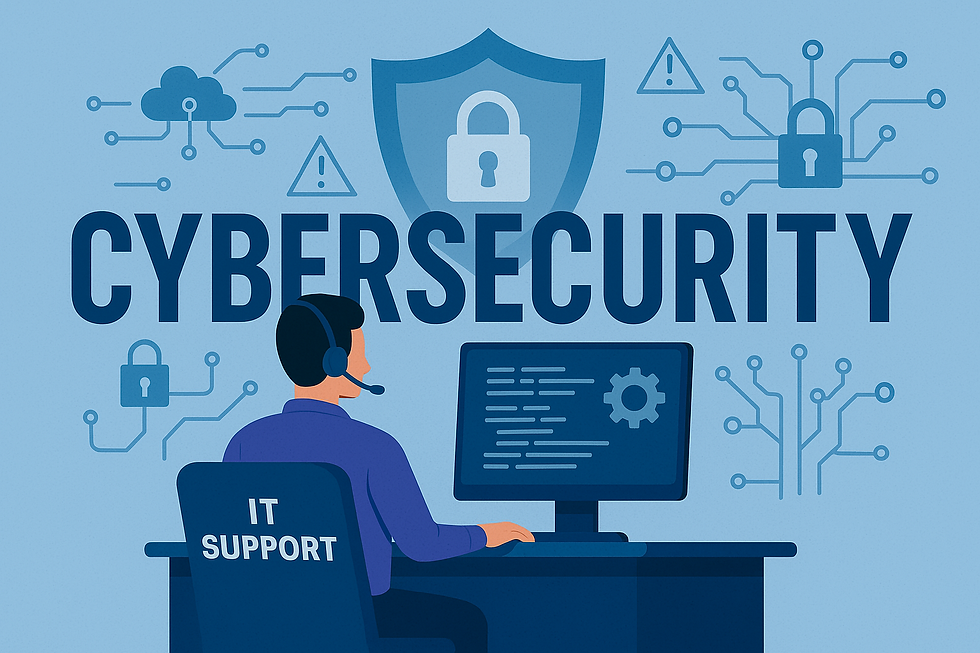
Every password reset request, unexpected error, or suspicious login attempt passing through IT support carries the potential to reveal a bigger security issue. Automated tools can generate alerts, but it’s the human context — the eyes and judgment of IT support — that determines whether those alerts prevent an incident or are missed opportunities.
Everyday Frontline Defense
On the frontline, IT support teams encounter threats disguised as ordinary problems:
A user forwarding a phishing email to “check if it’s safe.”
A device repeatedly failing compliance checks due to missed updates.
An unusual request for access to restricted systems.
Modern endpoint protection platforms — whether Microsoft Defender for Endpoint, CrowdStrike Falcon, or similar tools — can flag anomalies, but they don’t close the loop. It is IT support staff who investigate, escalate, or contain the issue before it escalates further. What appears to the user as “just fixing a laptop” may in fact be disrupting the early stages of an attack.
Bridging Users and Security
IT support operates at the intersection of users and policies. For non-technical staff, security rules can feel abstract. When IT support steps in — explaining why a suspicious link matters, or enforcing multi-factor authentication — they translate security policies into practical behavior changes. This role in raising awareness and guiding user actions makes IT support an invisible but critical security educator.
Why IT Support Is Undervalued
Despite these responsibilities, IT support is often undervalued, seen as purely technical troubleshooters. Organizations that underinvest in IT support training and tools miss the opportunity to strengthen their security posture at the earliest possible stage — where prevention is most effective.
The Future of IT Support in Cybersecurity
As technology advances, the role of IT support is shifting from reactive problem-solving to proactive defense enablement. AI-driven monitoring and predictive analytics will further enhance endpoint protection, but these technologies will still rely on human expertise to interpret context and guide responses. Future-ready IT support teams will be security enablers, not just troubleshooters.
Cybersecurity doesn’t begin in a data center or SOC — it begins at the helpdesk.
Conclusion
Cybersecurity doesn’t begin in a data center or SOC — it begins at the helpdesk. Every resolved ticket, every suspicious report handled, every patch enforced represents a frontline defense action. IT support may be the overlooked layer of cybersecurity, but it is also the foundation on which all other defenses stand.
Organizations that recognize and empower IT support staff are not just fixing issues — they are strengthening their first line of cyber defense.
If you’ve seen how IT support makes real cyber impact, let’s connect or tag someone deserving below!



Critical thought on the first line IT manpower. They are equal important like the top order guards in the IT industry.
Very nicely explained. Totally agree with you.